









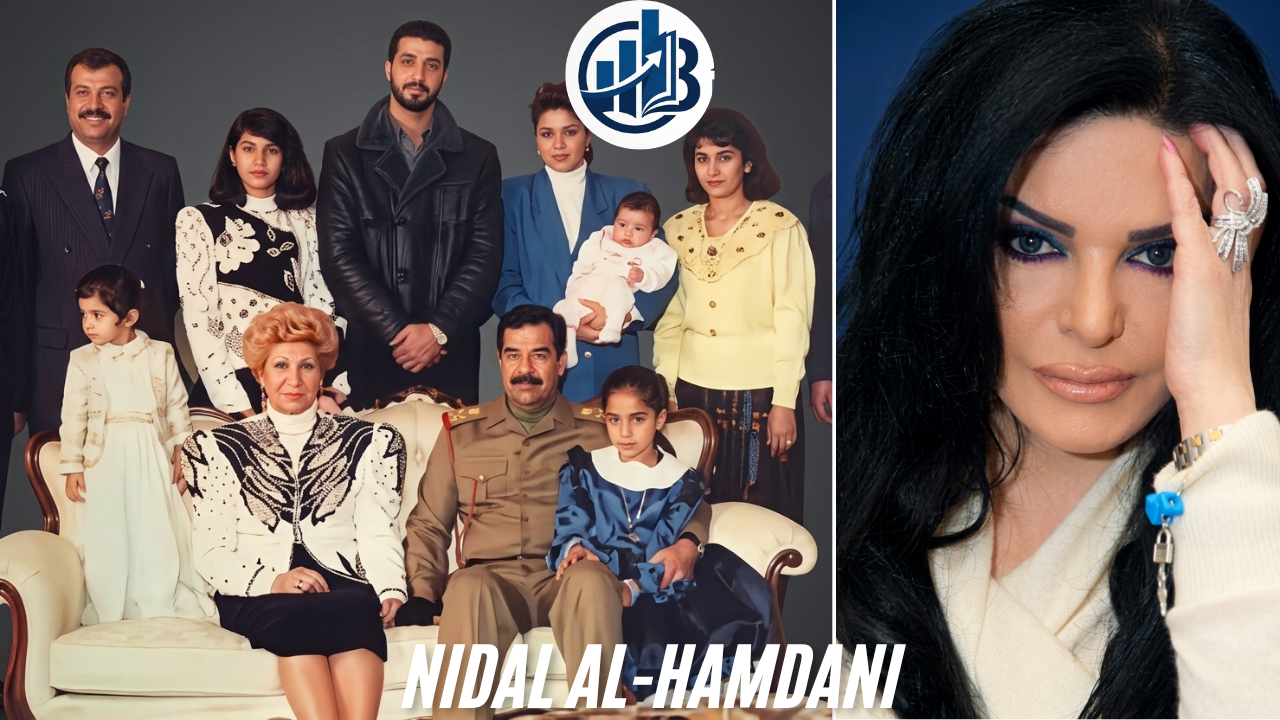
Nidal al-Hamdani is a name that appears at the intersection of science, politics, and historical uncertainty. She is most commonly described as an Iraqi scientist who worked within the country’s solar energy research system and, in many accounts, as one of Saddam Hussein’s wives. That combination alone has kept her name circulating in biographies, databases, and retrospective political histories.
But here’s the complication: while her association with Iraq’s scientific institutions is relatively consistent across sources, many details of her personal life—especially her relationship to Saddam Hussein—are reported rather than firmly documented. The result is a biography that is widely repeated but unevenly verified.
A scientist in Iraq’s state research system
Most accounts place Nidal al-Hamdani within Iraq’s Council of Scientific Research, specifically as the general manager of the Solar Energy Research Center. This role suggests a senior administrative and scientific position in a country that, during the late 20th century, invested heavily in state-directed research programs.
Solar energy research in Iraq during that period was tied to broader national goals of energy diversification and technological development. Scientists working in these institutions were typically part of government-linked structures, meaning their careers often blended technical work with state oversight. In that environment, senior managers like al-Hamdani would likely have been responsible for coordinating applied research projects rather than working in isolation as independent academics.
There is little publicly verified information about her early education, academic publications, or specific scientific breakthroughs. That absence is not unusual for Iraqi research officials of the era, where documentation was often internal and not widely disseminated outside state systems.
How her name became tied to Saddam Hussein
Nidal al-Hamdani’s public profile expanded significantly because of repeated claims that she was married to Saddam Hussein. Multiple modern summaries describe her as his third wife, with the marriage often placed around 1990 and lasting until his death in 2006.
These accounts typically also describe her as part of Saddam Hussein’s inner circle through this relationship, while maintaining her professional identity as a scientist. One widely cited biographical record notes her position in solar energy research while also listing her as a spouse of the Iraqi president, reflecting how political and personal narratives became intertwined in later reporting.
However, there is an important distinction between repetition and confirmation. While Saddam Hussein’s known family structure is well documented in general historical records, details about additional marriages—particularly outside his first wife Sajida Talfah and his widely reported second marriage to Samira Shahbandar—are less consistently supported by primary documentation. As a result, Nidal al-Hamdani’s status as a spouse is often described as “alleged” or “reported” rather than definitively confirmed in official archives.
Why her biography remains unclear
Part of the uncertainty around Nidal al-Hamdani comes from how information was recorded and preserved in Iraq during Saddam Hussein’s rule. The political system tightly controlled personal and institutional records, especially those connected to senior officials and sensitive state sectors.
After 2003, the collapse of state institutions and the dispersal of archives further complicated efforts to reconstruct accurate biographies. Many records were lost, inaccessible, or never made public. That created space for secondary accounts—journalistic summaries, encyclopedic entries, and retrospective biographies—to fill in the gaps.
Here’s where it gets interesting: when multiple secondary sources repeat the same claim without citing primary documentation, the information can become “accepted” in public discourse even if it was never fully verified. Nidal al-Hamdani’s biography sits in that exact space.
The challenge of separating role from narrative
What makes al-Hamdani’s story particularly difficult is the overlap between her professional identity and political association. On one hand, she is consistently described as a senior figure in Iraq’s solar energy research efforts. On the other hand, she is frequently included in lists of Saddam Hussein’s spouses, which places her within one of the most closely scrutinized private lives in modern political history.
That dual framing changes how her story is interpreted. As a scientist, she represents Iraq’s attempt to build technical expertise within state institutions. As a rumored political spouse, she becomes part of the broader narrative surrounding Saddam Hussein’s personal and political power structure.
Neither role is fully documented in a way that allows for a complete, independently verified biography. Instead, her name appears across fragmented references, each emphasizing different aspects of her life.
What can be stated with confidence
The most grounded summary is also the simplest. Nidal al-Hamdani is consistently identified as an Iraqi scientific administrator associated with solar energy research under Iraq’s Council of Scientific Research. That role is the most stable element of her public profile.
Her reported marriage to Saddam Hussein is widely repeated in modern biographical summaries, but not equally supported by accessible primary-source documentation. Because of that, it remains part of her public narrative but not a fully verified historical fact.
What remains, then, is a figure defined as much by absence as by presence—present in institutional memory as a scientist, and present in political histories as a disputed figure within Saddam Hussein’s personal life.
Why her story still attracts attention
Interest in Nidal al-Hamdani continues for a simple reason: she represents a rare overlap between scientific work and proximity to authoritarian power. That combination naturally draws curiosity, especially in historical contexts where transparency was limited.
There is also a broader pattern at play. Figures connected to closed political systems often reappear in fragmented form, shaped by incomplete records and later reinterpretations. Al-Hamdani’s biography reflects that pattern clearly.
So what does this mean in practice? It means her story is best read not as a fully settled biography, but as a case study in how history is reconstructed when documentation is partial and political narratives are layered on top of scientific careers.
Frequently Asked Questions
Who is Nidal al-Hamdani?
She is an Iraqi figure described in multiple sources as a senior solar energy research administrator and, in some accounts, a wife of Saddam Hussein.
What was her role in Iraq’s scientific system?
She is most often identified as a manager within the Solar Energy Research Center under Iraq’s Council of Scientific Research.
Was Nidal al-Hamdani officially confirmed as Saddam Hussein’s wife?
Her marriage to Saddam Hussein is widely reported but not consistently supported by accessible primary records, so it remains unconfirmed in strict historical terms.
Why is there so little verified information about her?
Limited archival access, state secrecy during Saddam Hussein’s rule, and post-2003 loss of records all contribute to gaps in her biography.
Did she have a scientific background?
Sources suggest she worked in a technical administrative capacity in energy research, though detailed academic records are not publicly available.
Where is Nidal al-Hamdani now?
There is no confirmed public information about her current location or activities after the fall of Saddam Hussein’s government.
Conclusion
Nidal al-Hamdani’s name persists in historical searches because it sits between two worlds: Iraq’s state-driven scientific institutions and the private life of one of its most powerful leaders. Yet neither side of her biography is fully documented in a way that closes the gaps.
What remains is a partial record shaped by institutional history, political narratives, and missing archives. That combination makes her less of a fully defined public figure and more of a historical reference point—one that still invites questions rather than final answers.